Reflections from the First Week.
27 02 2008The first thing that you should know about Cuba—and most of Latin America for that matter—is that life here is a lot more relaxed than in the United States. This is not to say that it is slow, but only that people understand what is truly important and what is not. For me, this change is refreshing. Still, I’ve found that while I may be relaxed the whole day, by night I still struggle to find out where it all went. For that reason I haven’t been able to update this site as frequently as I wanted too.
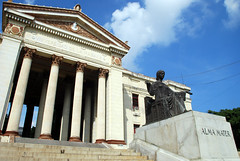
The big news this week—for me, at least—is that classes started at the University of Havana. I’m in six right now and by next week will have to limit it to five: Latin American Philosophy, Sociology of Education, Political Sociology, History of Cuba (1920-1959), History of Latin America (1930-today), and History of the United States. Professors here are incredibly engaging and classes are a lot livelier than what I’ve seen to be the average back home. Several times per class everyone will just start talking at the same time to bring their perspective to a contested issue. Another thing you should know about Cubans is that when they get excited about a topic, their voice raises and it appears that they may be on the verge of throwing fists.
Another thing I’ve noticed about Cubans is that they are incredibly well-informed of international events (despite communications limitations imposed by the Cuban government and U.S. blockade) and how those events connect back to the island. The class president for FEU (University Students Federation) is in one of my classes and made a great point: “You have to stay informed, but more importantly, you have to analyze what you hear. There is no such thing as an objective source.”
The FEU is a very important part of life here in Cuba—both within and outside of the university campus—and it organizes everything from conferences, intramural sports, lectures, social events, and exchanges (this weekend there will be an exchange between the U.S. students here and Cubans because of how biased perspectives are between the two countries). I talked to him a little bit about how student government works in the U.S. and at Bowdoin and he was very disappointed—especially about our elections in which nobody votes and hardly anybody runs. Here student government has policy implications on a university, municipal, provincial, and national level (FEU elects one of its members to the National Assembly each year).
I’ve been meeting a lot of incredible people here—both Cubans and other international students. The University of Havana has international reach and for this I’ve already had classes with students from Peru, Zimbabwe, Brazil, the Dominican Republic, Germany, the United Kingdom, and Angola, just to name a few. Many of these students are here for free because Cuba believes that everyone should have access to education, not just the privileged. Other people I’ve met include the parents of Cuba’s former ambassador to Bolivia and Haiti who now runs one of the ministries and the wife of one of the Cuban 5 (you should look that one up and make your own conclusions).
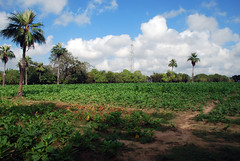
Over everything, Cubans live a humble life. The President of the University lives next door to shop keepers and laborers in nearly identical conditions. For his high position, he is rewarded with a car (which we got to borrow the other day). You’d be hard pressed to find a place where people are on such an equal footing than in Cuba. Yes, they are poor and opportunities can be considered limiting. I haven’t been able to find the kind of poverty that exists in the U.S. and other “first-world” countries though so like everything, you have to make a judgment on whether or not that is a good thing. The U.S. blockade of Cuba has made things very difficult here so it’s hard to say what life would be like if the current system were in place and the blockade not. Some things would be better, others the same, and others worse. U.S. development brings progress to other countries, but as we’ve learned, it also brings a lot of terrible consequences such as class conflict and environmental degradation. As I fully acknowledge that the blockade is inhumane, I also feel so lucky to be in a place where McDonald’s doesn’t exist and you can travel 15 minutes from the center of the city and be in the country side.
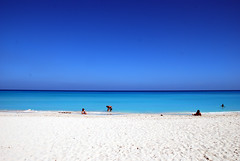
This is just the beginning of my thoughts about la situación cubana and as I continue to learn—and analyze—I’ll update things here. Hopefully in the next few weeks I’ll get some pictures put up so just keep an eye on the side bar on the right and if it looks like Cuba, there’ll be about 60 others on my Flickr site.
Categories : Daily Life, First Impressions