Mexican Food & Another Week in La Habana

23 03 2008

I just got back from my most satisfying food experience in Cuba and my first trip to a paladar. Located in Miramar, Mi Jardín serves some of the best Mexican food I’ve had outside of México. Given that Cubans don’t particularly use many key staples of Mexican food, everything at Mi Jardín is made from scratch right at home: the tortilla chips, tortillas, salsa verde, refried beans, you name it. I had an excellent pork dish and shared chips with beans, cheese, and salsa. You have no idea how much I’ve missed cilantro and jalapeños. Now that we’ve found this gem, I’ll probably eat here at least every two weeks. Yesterday, I found some burgers that tasted like they were cooked at a barbecue in the U.S. so I’ve been doing quite well with food this weekend. Not to mention we had pizzas a la orden on Friday night at the residence.

Aside from a weekend of great food, I’ve been exploring a few more parts of the city as I prepare for several trips out of Havana. On Friday we went to a cigar factory where I enjoyed a Cohiba in their ultra-swank cigar room with bone-chilling air conditioning. Afterwards, we walked around the inside of the Capitolio which is used for tours now instead of housing the National Assembly which wouldn’t fit the old halls. The building is designed after the U.S. Capital complete with two sides and a central dome (see pictures on Flickr). The first thing you’ll notice walking in is a huge (three-story) statue of what I imagine is lady justice or liberty. There’s also a glass case built into the exact center of the floor which used to house a diamond until that was stolen by a senator in the 30s (the stone in the middle is a replica). Walking through the building we visited the ornate hallways, meeting rooms, and library which functions to this day and is open to use from Cubans. I think I’ll be able to get in there with my carné so I may try and study there one day. I also have to visit the building again to go on a guided tour which allows you to sit in the President’s chair for a photo op in the old meeting room of the National Assembly.

It’s rained the past two nights in a row so we’ve stayed at the Residence. The journalists left yesterday and now there’s a group of writers from 14 different countries in America here for the next week. Hopefully that means we’ll get an official welcome party tomorrow night! If not, we’ll certainly get one the next week when the new group of journalists arrives for the next class beginning on April 2. Looking ahead towards the future, I’m planning on going to Matanzas next week for a trip to experience santería and in a few weeks I hope to go to the Oriente for a whole week to visit Santiago de Cuba, the Sierra Maestra, Guantanamo, and Baracoa. Now I’ve got to finish up a paper on Brasil under president Getúlio Vargas.


A weekend with Latin American journalists.

16 03 2008

Last Wednesday, most of the other students from the United States left Havana for an educational excursion to Trinidad and Santa Clara. Those of us from the SUNY program had to stay though since we take classes directly with the University of Havana. While the Residence was a little bit quieter, there was plenty going on. Friday marked the National Day of the Press so a party was held here at the Residence of the José Martí International Institute of Journalism.

From 7:00 on Friday night to 3:00 Saturday morning, I celebrated the occasion with journalists from across America (North, South, and the Caribbean). We sat around a table with drinks on the house (the State) and sang songs from our respective countries. Represented at the table were songs from Cuba, Panama, Ecuador, Mexico, Nicaragua, Brazil, the Dominican Republic, and of course—the United States. I settled with Calle 13 featuring Orishas “Pal Norte.” While it may not be a traditional song back home, the U.S. obviously plays a central role in the song as the country many refer simply as el norte.

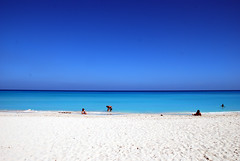
Saturday—despite being out until the early hours that morning—we woke up at 6:00 a.m. to begin a four hour journey to Santa Clara. As our school bus pulled up, complete with wooden seats, I knew we were going to be in for a long drive. Just about an hour out from Havana though, we found ourselves back in Cuba as the bus broke down and we were stranded on the highway. With a van coming to pick us up (all 15), the driver was finally able to fix the bus about two hours later and we made our way back to the city instead of risking getting stuck again. Everything worked out and by noon I was sitting back on the white sand and crystal clear waters of Guanabo with some other international students from the University.

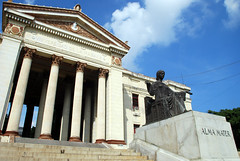
Sunday began early as well since we changed the hour here and 9:00 breakfast suddenly felt like 8:00. Shortly after, four journalists and I walked down Avenida de los Presidentes to catch the P-11 heading toward Habana Vieja. We spent a few hours at the Museum of the Revolution and later the Granma Memorial. There’s so much history in that building though (the old Presidential Palace) so I’m sure I’ll be going back again for a third visit sometime soon. Next up was a stop at the Camera Oscura where we got a pretty cool view of the entire city.

Finally, after lunch at the Residence, we took another bus to Miramar where the National Aquarium is. Of course, no visit to an aquarium is complete without a dolphin show and I’ve never seen one so cool. One of the highlights has to be seeing the dolphins dance to different types of popular music here in Cuba—merengue, then reggeaton, and finally rock (which is ridiculously popular in Havana). Speaking of something you wouldn’t expect to be popular here, Cubans love the theme song from Titanic. It played no less than three times during a two hour visit to the aquarium. On our way back, I took advantage of being in Miramar to find the Supermarket (actually Giant or Safeway sized, but it was closed early for some reason) and the only Mexican restaurant in Havana. Now I should seriously think about doing some reading since I have a semanario tomorrow at 8:00 a.m.


U.S. Interests Section in Havana

13 03 2008

Today I went to one of the places most shrouded in mystery back north: the U.S. Interests Section in Havana. Not only are we talking about Havana—a place that people either think is a 1950s paradise or a modern-day example of inefficiency and dictatorship—we’re talking about the building that represents the interests of a country that does not have diplomatic relations with Cuba. My trip was for routine business, but the experience was far from ordinary.

You don’t need the address of the Interests Section to find out where it is in Vedado. Just head towards Malecón and look for hundreds of flags. Normally they’re black flags to represent people who the Cuban government claims have died either trying to reach the U.S. or at the hands of people who had the support of the U.S. Every once in a while they’re Cuban flags, usually on days of national importance such as when Raúl was elected president. Today there were no flags; I think they were repairing the poles. Looking past the hundreds of flag-less flag poles, you’ll notice a huge stage complete with revolutionary slogans and messages about the Cuban Five.

Now that I could see the multi-story, fortress-like complex, I had to pass through Cuban police to gain access to the sidewalk where the entrance to the Interests Section is. Normally I cross the street wherever I need to, but as soon as I did that the police whistled at me and instructed me to cross at the corner. After crossing the street, I went through my first checkpoint, presenting my U.S. Passport. I waited in line for a few moments until word got out that I was norteamericano and the police let me go ahead to the front of the line to wait to go through security. Again, once they found out I was from the U.S., I was moved to the front of the line at security and ushered in through an unmarked door to go through security once again. Now inside the building, I made it past a waiting area for Cubans seeking visas to come to the U.S. and finally through a locked door marked “U.S. Citizen Services.” Along the way, I stopped to look at the items deemed worthy to be hanging on the wall: a letter from Fidel to FDR and pictures of what seemed like hundreds of Cuban political prisoners and the locations of their jails.

Anyway, I was hardly surprised to find out that I was the only U.S. citizen in the Interests Section so I got my questions answered right away. To my surprise though, the staff (members of the Foreign Service) were incredibly open and hardly suspicious of my presence in Cuba. They were familiar with my program and after I got everything sorted out, we even traded information about where the best burgers could be found in Havana.

Aside from my visit to the Interests Section, the past week had been low-key. Classes were cancelled yesterday afternoon for the Cultural Festival sponsored by the FEU (which was sweet) and next week I’ve got my first round of seminarios—class-wide debates where participation counts for a grade. This weekend I’m planning on going to the beach again and with any luck I’ll finally get my carné tomorrow.


Guanabo and my first marathon.

9 03 2008

Last week, one of my teachers started class by asking if we liked having class on Friday. As you can imagine, none of us did—and neither does he. For this, our class schedule was changed around and I now have my regular schedule back. That’s to say, a three day weekend every weekend.

I took advantage of my first Friday off by taking a guagua to Guanabo, a beach not more than 15 miles from the center of Havana. It took us about an hour to get there which is on the short side of things since we made caught a bus within minutes of getting to each stop. As I’ve mentioned before, they were packed. This time more so than I’ve seen before. On one of them the fare collector had to push people away so we could get moving and then eventually once we were going full speed people got far enough away from the doors that they could close. The 30 minute ride on the 400 from the Navy Hospital just after the Tunnel from Habana Vieja to Habana del Este was most memorable when we passed a slower moving 400 bus and we got to shout out to the other people about how fast our bus was going.

We first got some pizza and later some fried rice with ham (refreshingly delicious) as we were looking for the other students we were supposed to meet. They didn’t have nearly as much luck as we did getting to Guanabo and it took them about an hour and a half longer than us. Not to mention they were on a separate part of the beach. You don’t make plans in Cuba—you just do things together from start to finish because if you try and make plans, something will inevitably happen to mess them up. Either way, we had a great time at the beach. I’ve never been in an ocean that warm not to mention in March. Hopefully it won’t take me too long to adjust to the Atlantic in New England! Speaking of New England—we talked about that in my U.S. History class including the Quakers who are called los cuaqueros here (pronounced Quack-er-os).

Yesterday, I got up early (a las 7) to run my first maratón. About eight of us went and at first we thought it was cancelled with we couldn’t find anybody at the University. Resigned to go back to the Residence and put another page into the “you-can’t-make-plans-in-Cuba” book, we finally found a huge group of students (between 1 and 2 thousand) and music playing at the makeshift starting line. After showing our meet (carné=ID card / carne=meet… I know it’s dumb, but whatever I find it amusing) proving our eligibility to run in the race and sign up to rep our facultad, the race started at 9:45. 10 minutes later, we were at the finish line. Yeah that’s right—I ran a marathon in 10 minutes. I guess Cuban marathons are a little shorter than what we normally think of a marathon.

This afternoon we’re traveling across the city in a quest to find the only Mexican food in Havana. In other news—my first set of pictures is up on Flickr. You can check them out at http://www.flickr.com/photos/ianyaffe or click the side bar on the right. They’re best viewed as a set so click on “Cuba I” to see the full thing. Until next time…

PS – the internet froze when I tried to put this up the first time so the Mexican food quest continues. Apparently the place we went to only has Mexican food on Monday, Tuesday, and Wednesday. We got some “burgers” which I’m pretty sure didn’t come from a cow, but were very tasty and then went to get ice cream at Coppelia. Unfortunately, something (Cuba) happened and after an hour in line, they closed down and we had to get ice cream at the tourist stands—an unthinkable price of 60 cents for a cone… More soon.


Reality check.

4 03 2008

You may have noticed that the majority of my posts convey a certain sense of idealism about what is really a very complicated reality here in Cuba. There are, of course, a lot of things I admire and love about Cuba and most importantly, Cuban people. Regardless of the political and economic circumstances that have forced many to leave the island and elevated others to new horizons, Cubans are above all orgulloso de ser cubano—proud to be Cuban. It’s hard to convey that sense of pride and identity to people in the United States because we so often lack a national culture to take pride in, not to mention certain decisions we’ve made in the past and continue to make today that influence the world in negative ways.

Still, there’s plenty to miss back in the US. In addition to friends and family, I find myself missing most the variety of food that we can easily obtain at nearly any hour of the day. Food here can be wonderful, but the most noticeable thing about it is a lack of spice. I can’t wait to get a burrito again and have hot sauce at my disposal.

The reason I’m writing today is because of a reality check I had about life in Cuba for Cubans. For extranjeros, I can imagine few places more unique and beautiful to visit (not to mention economical). Cubans on the other hand, live a truly difficult life and are not allowed free access to travel, the internet, and conversation with foreigners. I have been asked for my carné (identification) every day now for the past three days. The first time was as I was trying to get into the Habana Libre hotel to buy something in their store (Cubans are not allowed inside the hotel). Today, I was sitting on the steps of the University with four white students from the United States and a police officer motioned to me (and only me) to come over and talk to him. Once I showed my carné proving that I am an extranjero, I was free to go about my way.

The plus side to this is that I never have trouble getting a máquina and never get hassled to pay for something in CUCs when that same item is available in pesos cubanos. Still, the heavy police presence here and everyday restrictions placed on Cubans shed light on some of the negative aspects of the Revolution. At the end of the day, you have to compare positive and negative aspects of the Revolution and make your own call on whether or not you think it’s a good or bad thing. My only hope is that at the end of my experience here I’ll be closer to being able to make that call with some type of objectivity and authority.


Public Transportation and last weekend

3 03 2008

Due to the fact that my passport is currently being processed by the Ministry of the Interior so I can get my carné (an ID card that proves Cuban residency), I am currently unable to travel outside of La Habana province. As if there wasn’t enough to do here. Once I get my carné though, I’ll be able to travel anywhere on the island in Cuban pesos (the train to Santiago de Cuba is about $3 USD or $72 pesos cubanos). Those rates are smartly not available to tourists but instead are reserved for Cubans and temporary residents (including students here for a semester or more). To put that price in perspective though, keep in mind that the average Cuban makes $450 pesos cubanos per month or about $19 USD. A train ticket is out of reach for most as a roundtrip is nearly one third of one’s monthly income.

Some other students were going to take the train to Cienfuegos only to find out when they arrived there at 6:00 a.m. that it only runs every other day. These types of things are common in Cuba where public transportation is fairly well developed (Cuba is the only Caribbean island with a train), but almost impossible to understand at best. To travel between provinces there are four options: airplane, train, bus, or hacer la botella (hitchhiking). Hitchhiking is such an important part of getting around Cuba that along the highway you will find amarillos or cops who are empowered to stop traffic so people can get a ride. By holding out a few pesos though, you’ll get picked up pretty quickly.

Public transportation in the city is extremely developed, but seems to lack a central planning system that would publish things like route maps or timetables. Most tourists will take tourist taxis (including the coco taxis which are sort of a motorcycle with two seats in the back… google it and you’ll see what I mean) for about $1 CUC per person (convertible peso which is valued slightly higher than the U.S. dollar). That price makes it obviously impossible for Cubans to take taxis as we know them.

Unless you’re walking or hitch hiking, you’ll have to ask around to figure out how to use the most common types of public transportation: collective taxis and buses. Máquinas (collective taxis) travel a fixed route and pick up passengers (Cubans and residents only) on the way charging $10 pesos cubanos (less than 50 cents) for the trip. Guagua is the term Cubans use for the local buses that travel all over the city. While there is clearly a system that the guaguas follow, there are no published schedules or maps and bus stop signs are only found here and there. Instead of looking up a time table and going to the nearest bus stop, you just walk around and ask people to give you advice and eventually you’ll find yourself at a cola (line) for that particular bus.

The next step is to ask for the último (basically who’s last) and once you find that person you become the último yourself (for a few minutes until the next person comes). This is the Cuban way of being in line without actually having to stand in line. Finally, among the guaguas there is a sub-section that called camellos. A camello is a Brazilian built semi cab with a Cuban built passenger section that crudely resembles a camel because of its distinctive humps. All buses are $1 peso cubano or less for the trip and they will be filled beyond capacity so prepare to get comfy.

With this understanding of public transportation, you can begin to make your journey anywhere in the city or across provinces (there are special inter-provincial buses for tourists and it might just be worth paying for them). On Sunday, I took the P-11 to the 400 which runs along the Habana del Este province home of a few great beaches. We visited the more “authentic” one called Guanabo which is almost devoid of tourists. While it was pretty windy (think sandstorm), it was great to relax on the beach for a few hours in the beginning of March and in the middle of a semester.

Today it was back to class—sort of. Classes here run on the same type of system as the guaguas so you never really know what to expect. Students generally have to wait for the professor—no matter how late he or she is—unless they have heard otherwise. There’s no ten minute rule here so we waited about 45 minutes until we gave up and went to lunch. Don’t get me wrong on this one. There are few places in the world that I think place as high a value on education as Cuba does, certainly not the United States. It’s just things notoriously happen at the last minute here so the schedule is more of a guideline than a regulation. Of nine classes I was scheduled to have in the past week, two were cancelled and two met at a different time.

Check out the classes section of this site for more info on the classes I’m taking. Also, I’m expecting about 60 pictures to go up online by the end of the week. Until then, I hope everything is going well wherever you are and look forward to hearing from you.