Last trips outside of Habana: Trinidad, Cienfuegos, and Santa Clara.
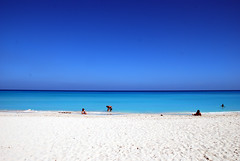
27 05 2008Last Tuesday I made the 150 mile yet six hour journey to Trinidad, Sancti Spíritus. We stayed at an incredible Casa Particular: Casa Muñoz which is described by the moon guide as the best casa in Trinidad. The beauty of Julio and Rosa Muñoz’s house is almost unbelievable—with tall ceilings and antique furniture, you can easily get lost in time. Of course, we didn’t have much time for that as it was already well past noon by the time we got settled in and we’d only have two days to explore this area. First stop was Playa Arcón, just a fifteen minute drive from town. Albeit beautiful, the beach annoyed me. Being that we’re getting into the hottest time in Cuba and Trinidad is on the southern side of the island, the water was absurdly warm. Like how a heated pool feels in the winter. Maybe warmer. You get the idea. To stay cool, you’d have to go in and get out real quick and let the breeze cool you off before the water evaporated off you in seconds.
Sunset brought much needed relief to the weather and another surprise: fresh fish for dinner. I knew we were going to have Red Snapper, but it was served to us high-class restaurant-style, that is, whole. I don’t doubt that the fish had been swimming just a few hours earlier. Delicious! You truly eat well when you stay in a Casa Particular, particularly when you get outside of the major cities and people go out of their way to please you because face it, there just aren’t as many tourists. Interestingly, Julio Muñoz has become famous enough that he has to turn people away! He’s so popular in Trinidad that other Cubans will impersonate him in order to get people to stay at their houses. This popularity rewards him and he says he’s able to support three families with his income, not to mention he’s the first Cuban I saw to sleep with air conditioning.
The evening made it a little easier to walk around and I got a chance to explore this city, from its cobblestone streets to brightly colored houses. The best part, as you’ll soon see in my photos, was the view from Julio’s roof. A combination of brick roofs, palm trees, blue skies, and a backdrop of mountains made that a pretty cool place to hang out. Of course, nighttime was upon us and we headed out to see Trinidad’s music scene. With Cuba Libres in hand, we enjoyed the quick beats of Cuban salsa on a grand outdoor escalinata (staircase) leading to the top of the local Casa de Musica.
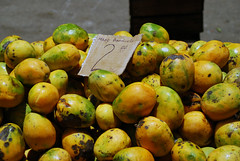
Next morning (after, of course, a great breakfast), we made our way to Parque Cubano, a small park on the outskirts of town that has a very cool waterfall. We spent the morning there, hiking to the waterfall and then having fun jumping into the refreshingly cold water from some quasi-cliffs above. The afternoon was spent wandering more of Trinidad and checking out a few museums. From the perspective of how deteriorated Habana is, Trinidad is really a miracle. We walked through houses that were centuries old and carried their original furniture and paintings. I also got to accomplish a mission that I’ve had since I arrived here: find the Trinidad library and see if a collection of books from the Brunswick-Trinidad Sister Association arrived. Mentioning the state of Maine was enough and the librarians immediately thanked the association for their generous donation and went about showing me how everything was being used. Libraries remain a very important place in Cuba as often the only place to get information about the world. Books are like fruit here: they only run in season (printed once) and once they’re gone, you have to wait until next year to taste them (also know as another edition). That being said, if the state doesn’t like oranges, you’ll probably only find apples for sale.
The next morning, we got up early to take the bus back westward, this time to Cienfuegos, literally translating to one hundred fires and sometimes even written 100 fuegos. Although many places were renamed after the Revolution, Cienfuegos predates it by many years and is not in honor of the revolutionary hero Camilo. Traveling there from Trinidad is especially important in a historical sense for the destiny of each town is intertwined. Trinidad is one of the oldest towns in Cuba and like other places, was founded first for the safety its harbor offered the Spanish fleet (and later pirates). Not too much later however, the Spanish encountered Cienfuegos Bay which is vastly superior to Trinidad and since then the city has prospered at Trinidad’s expense. It is for this precise reason that Trinidad remained colonial-looking while Cienfuegos developed, ironically turning Trinidad into a much more attractive tourist destination and bringing prosperity again to the town.
Walking from the bus terminal, the first thing I noticed was how clean the city was. It really reminded me of Santiago de Cuba. Surprise, surprise! In the center of Cienfuegos is Plaza Martí which is surrounded my many beautifully restored buildings including a church, theater, and college. From there we headed to the edge of the bay, but first by walking along Avenida 54 which is heavily commercialized (with CUC stores) and reminded me a lot of Malecón in Puerto Vallarta. Along the way to Punta Gorda, I couldn’t help by notice a Yacht Club with something you don’t see often in Cuba—yachts. I could see the masts of what must have been several sailboats longer than forty feet each and in the distance, a 100 plus foot mega yacht flying a Bahamas flag. Despite the Helms-Burton act, international tourists still manage to get to Cuba in what’s probably the most rewarding way possible: by sea. Punta Gorda is most notable for the “jewel of Cienfuegos,” the Palacio de Valle, with incredible views and some really good lemonade (con Havana Club, por supuesto).
Taking a horse wagon back into town, I made my way to the bus station where I knew I’d be able to find a Cuban with a car who wanted a few CUCs in exchange for a ride to Santa Clara, one hour away. Paying $15 CUC, I got the ride there along with two Cubanas who drove another taxi driver crazy. He tried to get them to go with him, but they refused noting that the girl he was interested in had two husbands and to hang out with her, “hay que tener una casa y dinero.” That sent him walking back to the station to try and catch some other tourists for a ride. The cubanas got out at their house on the way as I continued north to Santa Clara.
Arriving in Santa Clara, I became immediately aware that it is both the center point of transportation in Cuba yet doesn’t really seem geared towards tourists at any sense. The two sites of importance to me there were the Plaza de la Revolución with the Che memorial and the Tren Blindado, the monument to one of Batista’s trains that Che derailed, giving him control of the city and therefore, the entire east of the Island. For people from Santa Clara, Che is the hero they trump—while he was a part of Fidel’s movement, they credit him with their freedom.
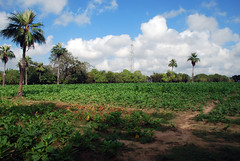
That brings me to an important question: Do Cubans support Fidel and Raúl or is this all just a political stunt orchestrated by a dictator? Obviously, the answer is not simple. You’ll find more discontent in the cities where opportunities are truly limited and exposure to foreigners creates a sense of relative deprivation. Of course, in those same cities you’ll find plenty of true loyal supporters to the revolution and many who are living quite comfortable (meaning they have access to dollars) be it through family connections abroad, work in the tourist sector, or high-level government jobs. Out in the country though, more people support the government because they are the ones who benefit most from it. A campesino is a lot better off today under Raúl than 50 years ago under Batista. While there is widespread discontent with the government (less than in La Yuma though), a large majority of the population here recognizes the tangible benefits that the Revolution has brought them.
And here I am—beginning my last week in Habana after a four month journey. I can’t believe I’m at this point and just as I’m excited to go home, I’m beginning to understand how much I’ll miss the Island that’s welcomed me as if it were home. Just as I’ll take a part of Cuba with me up north, a part of me will always stay here.
Categories : Politics, Travels