Public Transportation and last weekend
3 03 2008Due to the fact that my passport is currently being processed by the Ministry of the Interior so I can get my carné (an ID card that proves Cuban residency), I am currently unable to travel outside of La Habana province. As if there wasn’t enough to do here. Once I get my carné though, I’ll be able to travel anywhere on the island in Cuban pesos (the train to Santiago de Cuba is about $3 USD or $72 pesos cubanos). Those rates are smartly not available to tourists but instead are reserved for Cubans and temporary residents (including students here for a semester or more). To put that price in perspective though, keep in mind that the average Cuban makes $450 pesos cubanos per month or about $19 USD. A train ticket is out of reach for most as a roundtrip is nearly one third of one’s monthly income.
Some other students were going to take the train to Cienfuegos only to find out when they arrived there at 6:00 a.m. that it only runs every other day. These types of things are common in Cuba where public transportation is fairly well developed (Cuba is the only Caribbean island with a train), but almost impossible to understand at best. To travel between provinces there are four options: airplane, train, bus, or hacer la botella (hitchhiking). Hitchhiking is such an important part of getting around Cuba that along the highway you will find amarillos or cops who are empowered to stop traffic so people can get a ride. By holding out a few pesos though, you’ll get picked up pretty quickly.
Public transportation in the city is extremely developed, but seems to lack a central planning system that would publish things like route maps or timetables. Most tourists will take tourist taxis (including the coco taxis which are sort of a motorcycle with two seats in the back… google it and you’ll see what I mean) for about $1 CUC per person (convertible peso which is valued slightly higher than the U.S. dollar). That price makes it obviously impossible for Cubans to take taxis as we know them.
Unless you’re walking or hitch hiking, you’ll have to ask around to figure out how to use the most common types of public transportation: collective taxis and buses. Máquinas (collective taxis) travel a fixed route and pick up passengers (Cubans and residents only) on the way charging $10 pesos cubanos (less than 50 cents) for the trip. Guagua is the term Cubans use for the local buses that travel all over the city. While there is clearly a system that the guaguas follow, there are no published schedules or maps and bus stop signs are only found here and there. Instead of looking up a time table and going to the nearest bus stop, you just walk around and ask people to give you advice and eventually you’ll find yourself at a cola (line) for that particular bus.
The next step is to ask for the último (basically who’s last) and once you find that person you become the último yourself (for a few minutes until the next person comes). This is the Cuban way of being in line without actually having to stand in line. Finally, among the guaguas there is a sub-section that called camellos. A camello is a Brazilian built semi cab with a Cuban built passenger section that crudely resembles a camel because of its distinctive humps. All buses are $1 peso cubano or less for the trip and they will be filled beyond capacity so prepare to get comfy.
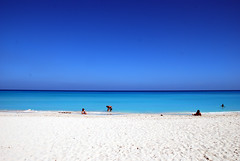
With this understanding of public transportation, you can begin to make your journey anywhere in the city or across provinces (there are special inter-provincial buses for tourists and it might just be worth paying for them). On Sunday, I took the P-11 to the 400 which runs along the Habana del Este province home of a few great beaches. We visited the more “authentic” one called Guanabo which is almost devoid of tourists. While it was pretty windy (think sandstorm), it was great to relax on the beach for a few hours in the beginning of March and in the middle of a semester.
Today it was back to class—sort of. Classes here run on the same type of system as the guaguas so you never really know what to expect. Students generally have to wait for the professor—no matter how late he or she is—unless they have heard otherwise. There’s no ten minute rule here so we waited about 45 minutes until we gave up and went to lunch. Don’t get me wrong on this one. There are few places in the world that I think place as high a value on education as Cuba does, certainly not the United States. It’s just things notoriously happen at the last minute here so the schedule is more of a guideline than a regulation. Of nine classes I was scheduled to have in the past week, two were cancelled and two met at a different time.
Check out the classes section of this site for more info on the classes I’m taking. Also, I’m expecting about 60 pictures to go up online by the end of the week. Until then, I hope everything is going well wherever you are and look forward to hearing from you.