Last trips outside of Habana: Trinidad, Cienfuegos, and Santa Clara.

27 05 2008

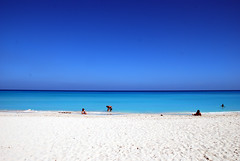
Last Tuesday I made the 150 mile yet six hour journey to Trinidad, Sancti Spíritus. We stayed at an incredible Casa Particular: Casa Muñoz which is described by the moon guide as the best casa in Trinidad. The beauty of Julio and Rosa Muñoz’s house is almost unbelievable—with tall ceilings and antique furniture, you can easily get lost in time. Of course, we didn’t have much time for that as it was already well past noon by the time we got settled in and we’d only have two days to explore this area. First stop was Playa Arcón, just a fifteen minute drive from town. Albeit beautiful, the beach annoyed me. Being that we’re getting into the hottest time in Cuba and Trinidad is on the southern side of the island, the water was absurdly warm. Like how a heated pool feels in the winter. Maybe warmer. You get the idea. To stay cool, you’d have to go in and get out real quick and let the breeze cool you off before the water evaporated off you in seconds.

Sunset brought much needed relief to the weather and another surprise: fresh fish for dinner. I knew we were going to have Red Snapper, but it was served to us high-class restaurant-style, that is, whole. I don’t doubt that the fish had been swimming just a few hours earlier. Delicious! You truly eat well when you stay in a Casa Particular, particularly when you get outside of the major cities and people go out of their way to please you because face it, there just aren’t as many tourists. Interestingly, Julio Muñoz has become famous enough that he has to turn people away! He’s so popular in Trinidad that other Cubans will impersonate him in order to get people to stay at their houses. This popularity rewards him and he says he’s able to support three families with his income, not to mention he’s the first Cuban I saw to sleep with air conditioning.

The evening made it a little easier to walk around and I got a chance to explore this city, from its cobblestone streets to brightly colored houses. The best part, as you’ll soon see in my photos, was the view from Julio’s roof. A combination of brick roofs, palm trees, blue skies, and a backdrop of mountains made that a pretty cool place to hang out. Of course, nighttime was upon us and we headed out to see Trinidad’s music scene. With Cuba Libres in hand, we enjoyed the quick beats of Cuban salsa on a grand outdoor escalinata (staircase) leading to the top of the local Casa de Musica.

Next morning (after, of course, a great breakfast), we made our way to Parque Cubano, a small park on the outskirts of town that has a very cool waterfall. We spent the morning there, hiking to the waterfall and then having fun jumping into the refreshingly cold water from some quasi-cliffs above. The afternoon was spent wandering more of Trinidad and checking out a few museums. From the perspective of how deteriorated Habana is, Trinidad is really a miracle. We walked through houses that were centuries old and carried their original furniture and paintings. I also got to accomplish a mission that I’ve had since I arrived here: find the Trinidad library and see if a collection of books from the Brunswick-Trinidad Sister Association arrived. Mentioning the state of Maine was enough and the librarians immediately thanked the association for their generous donation and went about showing me how everything was being used. Libraries remain a very important place in Cuba as often the only place to get information about the world. Books are like fruit here: they only run in season (printed once) and once they’re gone, you have to wait until next year to taste them (also know as another edition). That being said, if the state doesn’t like oranges, you’ll probably only find apples for sale.

The next morning, we got up early to take the bus back westward, this time to Cienfuegos, literally translating to one hundred fires and sometimes even written 100 fuegos. Although many places were renamed after the Revolution, Cienfuegos predates it by many years and is not in honor of the revolutionary hero Camilo. Traveling there from Trinidad is especially important in a historical sense for the destiny of each town is intertwined. Trinidad is one of the oldest towns in Cuba and like other places, was founded first for the safety its harbor offered the Spanish fleet (and later pirates). Not too much later however, the Spanish encountered Cienfuegos Bay which is vastly superior to Trinidad and since then the city has prospered at Trinidad’s expense. It is for this precise reason that Trinidad remained colonial-looking while Cienfuegos developed, ironically turning Trinidad into a much more attractive tourist destination and bringing prosperity again to the town.

Walking from the bus terminal, the first thing I noticed was how clean the city was. It really reminded me of Santiago de Cuba. Surprise, surprise! In the center of Cienfuegos is Plaza Martí which is surrounded my many beautifully restored buildings including a church, theater, and college. From there we headed to the edge of the bay, but first by walking along Avenida 54 which is heavily commercialized (with CUC stores) and reminded me a lot of Malecón in Puerto Vallarta. Along the way to Punta Gorda, I couldn’t help by notice a Yacht Club with something you don’t see often in Cuba—yachts. I could see the masts of what must have been several sailboats longer than forty feet each and in the distance, a 100 plus foot mega yacht flying a Bahamas flag. Despite the Helms-Burton act, international tourists still manage to get to Cuba in what’s probably the most rewarding way possible: by sea. Punta Gorda is most notable for the “jewel of Cienfuegos,” the Palacio de Valle, with incredible views and some really good lemonade (con Havana Club, por supuesto).

Taking a horse wagon back into town, I made my way to the bus station where I knew I’d be able to find a Cuban with a car who wanted a few CUCs in exchange for a ride to Santa Clara, one hour away. Paying $15 CUC, I got the ride there along with two Cubanas who drove another taxi driver crazy. He tried to get them to go with him, but they refused noting that the girl he was interested in had two husbands and to hang out with her, “hay que tener una casa y dinero.” That sent him walking back to the station to try and catch some other tourists for a ride. The cubanas got out at their house on the way as I continued north to Santa Clara.

Arriving in Santa Clara, I became immediately aware that it is both the center point of transportation in Cuba yet doesn’t really seem geared towards tourists at any sense. The two sites of importance to me there were the Plaza de la Revolución with the Che memorial and the Tren Blindado, the monument to one of Batista’s trains that Che derailed, giving him control of the city and therefore, the entire east of the Island. For people from Santa Clara, Che is the hero they trump—while he was a part of Fidel’s movement, they credit him with their freedom.

That brings me to an important question: Do Cubans support Fidel and Raúl or is this all just a political stunt orchestrated by a dictator? Obviously, the answer is not simple. You’ll find more discontent in the cities where opportunities are truly limited and exposure to foreigners creates a sense of relative deprivation. Of course, in those same cities you’ll find plenty of true loyal supporters to the revolution and many who are living quite comfortable (meaning they have access to dollars) be it through family connections abroad, work in the tourist sector, or high-level government jobs. Out in the country though, more people support the government because they are the ones who benefit most from it. A campesino is a lot better off today under Raúl than 50 years ago under Batista. While there is widespread discontent with the government (less than in La Yuma though), a large majority of the population here recognizes the tangible benefits that the Revolution has brought them.

And here I am—beginning my last week in Habana after a four month journey. I can’t believe I’m at this point and just as I’m excited to go home, I’m beginning to understand how much I’ll miss the Island that’s welcomed me as if it were home. Just as I’ll take a part of Cuba with me up north, a part of me will always stay here.


Isla de la Juventud and el Primero de Mayo.

1 05 2008

Last weekend I continued my trend of traveling by paying a visit to Cuba’s largest island, Isla de la Juventud (Isle of Youth). We got up early Friday morning and after about half an hour searching the bus station, we finally found the check-in line and eventually got on the Astro bus heading to Batabanó, the departure port for Isla. I knew that we’d be riding on a high-speed catamaran, but I had no idea how nice the boat was going to be until I got aboard. For those of you in New England, this resembles the New England Fast Ferry except that it also is equipped with flat screen TVs that show the latest movies and shows from the U.S. (the ones that aren’t out on DVD yet). The ferry is also equipped with high security than we have at airports including police patrols (on board), metal detectors, and X-rays; this boat could easily out run the Cuban Coast Guard and be used to emigrate to Mexico. The 80 km journey took about two and a half hours and about six hours after leaving Havana we were in Nueva Gerona, capital town of Isla de la Juventud. After getting settled and making our excursion reservations with EcoTur, we explored Nueva Gerona and spent the rest of our night at the local bar, El Cochinito.

Saturday morning I was up early again, this time to head across the island to Punta Frances, the southwest corner of the island that is inaccessible by road and today largely hosts a nature preserve. To get there, we took a taxi to El Colony and then boarded an old 40 foot Sportfisher which took us the rest of the way by sea. It was great to be out on the water again (as opposed to stuck inside the ferry). The beach site we were at used to be very popular when the Spanish Oceanliner Pulmantur made weekly stops here, but since that vessel was bought by a U.S. firm it is no longer allowed to touch Cuban waters (Helms-Burton Act). The positive side of that transaction is that the beach is completely empty. We spent the morning snorkeling and then after convincing the Captain that my Firefighter’s ID included SCUBA certification, I departed for an afternoon dive in one of the many coral reefs that surround the area.

I should start by saying that I’ve never been diving before, but heard that Cuban waters were something not to be passed up. After a five minute crash-course, I jumped off the stern of our boat and after deflating my vest, began to descend into the reef. It took a few (excruciating) moments to get used to the pressure, but after then I enjoyed all 48 minutes that I stayed under water. Think about all those ridiculous pictures of absurdly blue waters and ridiculously beautiful fish that you’ve seen in magazines and on the internet. It was just like that.

Back in Nueva Gerona, the time for the second amazing part of the day was nearing: our surf and turf dinner (off the black market, of course). We shared four lobsters and at least two pounds of steak for the five of us (plus all the fixings)! With a long day of being on the beach and walking around town behind us, we went to bed early to begin our return trip at 6:30 a.m. on Sunday, arriving back in Havana without too much difficulty by 1:30 p.m. The rest of the week went by without too much event… until today that is.

May 1–Día de los Trabajadores—is one of three major holidays in Cuba (in addition to July 26 and January 1). Pretty much everything gets shut down as people prepare to march on the Plaza de la Revolución. By 6:30 a.m., the streets are bustling with activity as people converge on starting points for the various routes that take people right to the José Martí monument in the center of the city. I met up with other students from Filosofía e Historia and by 7:30 a.m., the march had begun. The colors of the day are red, white, and blue (the colors of the Cuban flag) and loud speakers carry revolutionary chants across the city.

More of a time to relax and socialize, the only real moment where everyone seemed to be actively participating in the march was passing under the watchful eyes of Raúl and other top government figures, some of whom use binoculars to better see the crowd. That isn’t to say that people don’t support the State, but as you can imagine, there’s only so many times you can say ¡Viva Raúl! or ¡Viva Cuba Libre! before it gets repetitive. Nevertheless, when the FEU was called, my entire section went crazy for about a minute, waving Cuban flags and shouting revolutionary chants.

I ran into one of my friends who is a Chilean journalist and managed to take my camera and get an incredibly close-up picture of Raúl himself (who is in the center of the whole event). After then, the march just sort of ended and people go their own ways, but I stayed around for a few extra minutes to see two important groups: the medical students (a few of whom flew U.S. flags) and trabajadores sociales (social workers) who flew hundreds of Cuban flags and street sized banners with slogans including one with Fidel’s picture. By evening, most of the events had finished and things were quiet as people got some much needed rest from such an early start. That’s what I’m about to do. Until next time.


Mantanzas, Santería, and Headlines from the Island.

2 04 2008

This past Saturday I spent my first night outside of Havana since I was in Toronto. That day and Sunday I was in Matanzas on a trip to learn all about Santería. We traveled aboard the guagua periodista which left us stranded last time I tried to take a trip on it. The bus showed up to the residence a few minutes early and left right on time—without any of us. An hour later, the driver told us he went to bread. Nevertheless, after about two bumpy hours on the highway, we arrived in Matanzas ready to begin our journey.

Some background: Matanzas is the province directly east of La Habana and its capital city is Matanzas. Within the province there are several spots of interest I hope to visit in the next month: Playa Girón (Bay of Pigs) and Veradero (allegedly home of the nicest beaches in Cuba). Santería is the hybrid religion that combines Catholicism with the traditional Yoruba religion of Nigeria. Barred from practicing their native religion and converted to Christianity, colonial slaves in Cuba kept their traditions alive by masking them with Catholic ones. The most obvious form of this practice is the connection between the orishas (spirits) and Saints. For example, Changó (the spirit of fire and war) is often connected with Santa Bárbara (that is not to say they are the same however).

With that covered, our first stop was the temple where we would also be staying on Saturday night. The Templo Otura Di was the first in Cuba (and second in the Americas) to ordain a female Babalawo (the spiritual leader of the temple roughly translating to “Father Who Knows the Secrets”). After learning about some of the customs and rituals of Santería, we traveled around the neighborhood to other templos to see the differences within the religion. Back at the Otura Di, we were part of a full ritual before spending some of the later hours exploring the city. Since we stayed in the houses of various santeros, there weren’t enough beds and I had the privilege of sleeping the back seat of a 1950s máquina.

Well rested, the next day we explored more of Matanzas before heading back to Havana on the bus. After my first night away from the capital, I was happy to be heading “home.” I’m also ready to get more aggressive about traveling around the island as much as I can. For the month of April I have a long list of places I’d like to visit including: Santiago de Cuba, Bayamo, Pico Turquino (the highest mountain in Cuba), Baracoa, Playa Girón, Isla de la Juventud, and the western most parts of Pinar del Río.

Aside from traveling, classes have been at a relaxed pace the past few weeks, but that just means we’ll be gearing up for another round of semanarios in the next few. If you’ve been reading the New York Times recently, you’ll notice that there are a lot of “major” changes happening here in Havana, all of them a loosening of restrictions that have been in place on Cubans for many years now. First was the legalization of the public sale of microwaves, DVD players, and eventually air conditioners, then garnering more headlines, the opening of the cell phone market to all Cubans. Just a few days ago, hotels were officially opened to all Cuban (who used to be prohibited from renting accommodations in tourist hotels even if they had the money to do so).

I’m not trying to take away from the significance of these changes, but would encourage people to think about them using a historical perspective. There’s a huge black market for items that the state doesn’t sell openly so any commodity that can be found on the island can be bought by a Cuban if they have the money to do so. The same goes for cell phones. The decision of the State to openly sell these items resulted from the need of Cuban’s to have access to these items as much as a necessity for the State which looses money when it doesn’t control the method of product distribution. The opening of hotels to Cubans is slightly more significant because that was something that could not be bought on the black market, although there were many ways for Cubans to gain official access to tourist hotels. We’ve now entered the “low” season as Europe warms up and tourism decreases and when you combine that with an overall decrease in tourism over the past few years, you’ll notice that this is a win/win for the state which gets to fill empty hotel rooms and make the (capitalist) world think that Cuba is changing.

What I find significant in these recent measures taken by Raúl Castro is that the government seems to be acknowledging that there are two classes of Cubans—those who have access to convertible pesos and those who don’t. There are two notable ways to gain access to convertible pesos: working in the tourist sector or for foreign businesses and having family residing abroad that sends remittances. From an economic standpoint, the growing availability of commodities available to Cubans with access to convertible pesos will serve as an additional incentive for Cubans to try and gain access to that type of currency. Given that the government can not increase salaries twenty-four fold, this means there is a greater incentive to work in the tourist sectors. Overall, I see the recent headlines as an acknowledgement of not only the existence of socioeconomic classes in Cuba, but more significantly, that the class of Cubans with convertible pesos is growing and gaining political power. Like everything, I’ll have to get in the cola to find out.


U.S. Interests Section in Havana

13 03 2008

Today I went to one of the places most shrouded in mystery back north: the U.S. Interests Section in Havana. Not only are we talking about Havana—a place that people either think is a 1950s paradise or a modern-day example of inefficiency and dictatorship—we’re talking about the building that represents the interests of a country that does not have diplomatic relations with Cuba. My trip was for routine business, but the experience was far from ordinary.

You don’t need the address of the Interests Section to find out where it is in Vedado. Just head towards Malecón and look for hundreds of flags. Normally they’re black flags to represent people who the Cuban government claims have died either trying to reach the U.S. or at the hands of people who had the support of the U.S. Every once in a while they’re Cuban flags, usually on days of national importance such as when Raúl was elected president. Today there were no flags; I think they were repairing the poles. Looking past the hundreds of flag-less flag poles, you’ll notice a huge stage complete with revolutionary slogans and messages about the Cuban Five.

Now that I could see the multi-story, fortress-like complex, I had to pass through Cuban police to gain access to the sidewalk where the entrance to the Interests Section is. Normally I cross the street wherever I need to, but as soon as I did that the police whistled at me and instructed me to cross at the corner. After crossing the street, I went through my first checkpoint, presenting my U.S. Passport. I waited in line for a few moments until word got out that I was norteamericano and the police let me go ahead to the front of the line to wait to go through security. Again, once they found out I was from the U.S., I was moved to the front of the line at security and ushered in through an unmarked door to go through security once again. Now inside the building, I made it past a waiting area for Cubans seeking visas to come to the U.S. and finally through a locked door marked “U.S. Citizen Services.” Along the way, I stopped to look at the items deemed worthy to be hanging on the wall: a letter from Fidel to FDR and pictures of what seemed like hundreds of Cuban political prisoners and the locations of their jails.

Anyway, I was hardly surprised to find out that I was the only U.S. citizen in the Interests Section so I got my questions answered right away. To my surprise though, the staff (members of the Foreign Service) were incredibly open and hardly suspicious of my presence in Cuba. They were familiar with my program and after I got everything sorted out, we even traded information about where the best burgers could be found in Havana.

Aside from my visit to the Interests Section, the past week had been low-key. Classes were cancelled yesterday afternoon for the Cultural Festival sponsored by the FEU (which was sweet) and next week I’ve got my first round of seminarios—class-wide debates where participation counts for a grade. This weekend I’m planning on going to the beach again and with any luck I’ll finally get my carné tomorrow.


Reality check.

4 03 2008

You may have noticed that the majority of my posts convey a certain sense of idealism about what is really a very complicated reality here in Cuba. There are, of course, a lot of things I admire and love about Cuba and most importantly, Cuban people. Regardless of the political and economic circumstances that have forced many to leave the island and elevated others to new horizons, Cubans are above all orgulloso de ser cubano—proud to be Cuban. It’s hard to convey that sense of pride and identity to people in the United States because we so often lack a national culture to take pride in, not to mention certain decisions we’ve made in the past and continue to make today that influence the world in negative ways.

Still, there’s plenty to miss back in the US. In addition to friends and family, I find myself missing most the variety of food that we can easily obtain at nearly any hour of the day. Food here can be wonderful, but the most noticeable thing about it is a lack of spice. I can’t wait to get a burrito again and have hot sauce at my disposal.

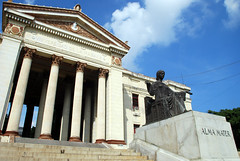
The reason I’m writing today is because of a reality check I had about life in Cuba for Cubans. For extranjeros, I can imagine few places more unique and beautiful to visit (not to mention economical). Cubans on the other hand, live a truly difficult life and are not allowed free access to travel, the internet, and conversation with foreigners. I have been asked for my carné (identification) every day now for the past three days. The first time was as I was trying to get into the Habana Libre hotel to buy something in their store (Cubans are not allowed inside the hotel). Today, I was sitting on the steps of the University with four white students from the United States and a police officer motioned to me (and only me) to come over and talk to him. Once I showed my carné proving that I am an extranjero, I was free to go about my way.

The plus side to this is that I never have trouble getting a máquina and never get hassled to pay for something in CUCs when that same item is available in pesos cubanos. Still, the heavy police presence here and everyday restrictions placed on Cubans shed light on some of the negative aspects of the Revolution. At the end of the day, you have to compare positive and negative aspects of the Revolution and make your own call on whether or not you think it’s a good or bad thing. My only hope is that at the end of my experience here I’ll be closer to being able to make that call with some type of objectivity and authority.


The End of an Era? What Fidel’s Message Means in La Habana.

19 02 2008

By now I’m imagining you’ve heard the “big” news—Fidel Castro has announced that he will not accept the Presidential nomination on Sunday when the National Assembly meets.  You may be thinking that La Habana is about to explode, but on that note you would most certainly be mistaken.  I am staying in the heart of the city—in an area called Plaza de la Revolución—and didn’t find out about Castro’s announcement until about an hour and a half after I woke up.  Even then, I found out by logging onto my email and seeing a breaking news alert in the Boston Globe.  It certainly isn’t breaking news here.  It’s just the official story of what everyone already knew.

Castro made his announcement at 5:00 a.m. today when the official newspaper of the Cuban Communist Party (PCC) Granma appeared at newsstands.  Castro had been promising a “mensaje” of great importance today and he certain didn’t let the Cuban people down.  A quick history lesson—Castro assumed power in 1959 meaning he has been Cuba’s leader for 49 years.  This is certainly an important day for Cubans, but more so as a formality rather than actual significance.  For those who believe now is a time of great transition in Cuba, I would say that transition began over a year and a half ago.

Our orientation at La Universidad de La Habana went along as scheduled, but we talked to a lot of people about the significance of today along the way.  The overwhelming feeling here is “no pasa nada” or, nothing’s happening.  The Cuban political system is far from being unstable.  You can bet that Fidel has been planning this moment with excruciating detail for the past year.  You can also bet that so long as he is living, he is going to be consulted on important decisions.

Nevertheless, on Sunday the National Assembly (of which Fidel is still a member) will elect its new leaders and there is still some speculation on who will become Cuba’s next president.  Next week will truly be the beginning of a new era in Cuba, but you won’t notice many (if any) changes on the street level.  I’ll keep you informed and please email if you have questions.