Guanabo and my first marathon.

9 03 2008

Last week, one of my teachers started class by asking if we liked having class on Friday. As you can imagine, none of us did—and neither does he. For this, our class schedule was changed around and I now have my regular schedule back. That’s to say, a three day weekend every weekend.

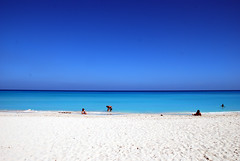
I took advantage of my first Friday off by taking a guagua to Guanabo, a beach not more than 15 miles from the center of Havana. It took us about an hour to get there which is on the short side of things since we made caught a bus within minutes of getting to each stop. As I’ve mentioned before, they were packed. This time more so than I’ve seen before. On one of them the fare collector had to push people away so we could get moving and then eventually once we were going full speed people got far enough away from the doors that they could close. The 30 minute ride on the 400 from the Navy Hospital just after the Tunnel from Habana Vieja to Habana del Este was most memorable when we passed a slower moving 400 bus and we got to shout out to the other people about how fast our bus was going.

We first got some pizza and later some fried rice with ham (refreshingly delicious) as we were looking for the other students we were supposed to meet. They didn’t have nearly as much luck as we did getting to Guanabo and it took them about an hour and a half longer than us. Not to mention they were on a separate part of the beach. You don’t make plans in Cuba—you just do things together from start to finish because if you try and make plans, something will inevitably happen to mess them up. Either way, we had a great time at the beach. I’ve never been in an ocean that warm not to mention in March. Hopefully it won’t take me too long to adjust to the Atlantic in New England! Speaking of New England—we talked about that in my U.S. History class including the Quakers who are called los cuaqueros here (pronounced Quack-er-os).

Yesterday, I got up early (a las 7) to run my first maratón. About eight of us went and at first we thought it was cancelled with we couldn’t find anybody at the University. Resigned to go back to the Residence and put another page into the “you-can’t-make-plans-in-Cuba” book, we finally found a huge group of students (between 1 and 2 thousand) and music playing at the makeshift starting line. After showing our meet (carné=ID card / carne=meet… I know it’s dumb, but whatever I find it amusing) proving our eligibility to run in the race and sign up to rep our facultad, the race started at 9:45. 10 minutes later, we were at the finish line. Yeah that’s right—I ran a marathon in 10 minutes. I guess Cuban marathons are a little shorter than what we normally think of a marathon.

This afternoon we’re traveling across the city in a quest to find the only Mexican food in Havana. In other news—my first set of pictures is up on Flickr. You can check them out at http://www.flickr.com/photos/ianyaffe or click the side bar on the right. They’re best viewed as a set so click on “Cuba I” to see the full thing. Until next time…

PS – the internet froze when I tried to put this up the first time so the Mexican food quest continues. Apparently the place we went to only has Mexican food on Monday, Tuesday, and Wednesday. We got some “burgers” which I’m pretty sure didn’t come from a cow, but were very tasty and then went to get ice cream at Coppelia. Unfortunately, something (Cuba) happened and after an hour in line, they closed down and we had to get ice cream at the tourist stands—an unthinkable price of 60 cents for a cone… More soon.


Reality check.

4 03 2008

You may have noticed that the majority of my posts convey a certain sense of idealism about what is really a very complicated reality here in Cuba. There are, of course, a lot of things I admire and love about Cuba and most importantly, Cuban people. Regardless of the political and economic circumstances that have forced many to leave the island and elevated others to new horizons, Cubans are above all orgulloso de ser cubano—proud to be Cuban. It’s hard to convey that sense of pride and identity to people in the United States because we so often lack a national culture to take pride in, not to mention certain decisions we’ve made in the past and continue to make today that influence the world in negative ways.

Still, there’s plenty to miss back in the US. In addition to friends and family, I find myself missing most the variety of food that we can easily obtain at nearly any hour of the day. Food here can be wonderful, but the most noticeable thing about it is a lack of spice. I can’t wait to get a burrito again and have hot sauce at my disposal.

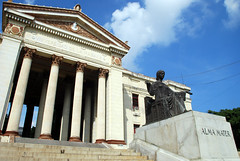
The reason I’m writing today is because of a reality check I had about life in Cuba for Cubans. For extranjeros, I can imagine few places more unique and beautiful to visit (not to mention economical). Cubans on the other hand, live a truly difficult life and are not allowed free access to travel, the internet, and conversation with foreigners. I have been asked for my carné (identification) every day now for the past three days. The first time was as I was trying to get into the Habana Libre hotel to buy something in their store (Cubans are not allowed inside the hotel). Today, I was sitting on the steps of the University with four white students from the United States and a police officer motioned to me (and only me) to come over and talk to him. Once I showed my carné proving that I am an extranjero, I was free to go about my way.

The plus side to this is that I never have trouble getting a máquina and never get hassled to pay for something in CUCs when that same item is available in pesos cubanos. Still, the heavy police presence here and everyday restrictions placed on Cubans shed light on some of the negative aspects of the Revolution. At the end of the day, you have to compare positive and negative aspects of the Revolution and make your own call on whether or not you think it’s a good or bad thing. My only hope is that at the end of my experience here I’ll be closer to being able to make that call with some type of objectivity and authority.


Public Transportation and last weekend

3 03 2008

Due to the fact that my passport is currently being processed by the Ministry of the Interior so I can get my carné (an ID card that proves Cuban residency), I am currently unable to travel outside of La Habana province. As if there wasn’t enough to do here. Once I get my carné though, I’ll be able to travel anywhere on the island in Cuban pesos (the train to Santiago de Cuba is about $3 USD or $72 pesos cubanos). Those rates are smartly not available to tourists but instead are reserved for Cubans and temporary residents (including students here for a semester or more). To put that price in perspective though, keep in mind that the average Cuban makes $450 pesos cubanos per month or about $19 USD. A train ticket is out of reach for most as a roundtrip is nearly one third of one’s monthly income.

Some other students were going to take the train to Cienfuegos only to find out when they arrived there at 6:00 a.m. that it only runs every other day. These types of things are common in Cuba where public transportation is fairly well developed (Cuba is the only Caribbean island with a train), but almost impossible to understand at best. To travel between provinces there are four options: airplane, train, bus, or hacer la botella (hitchhiking). Hitchhiking is such an important part of getting around Cuba that along the highway you will find amarillos or cops who are empowered to stop traffic so people can get a ride. By holding out a few pesos though, you’ll get picked up pretty quickly.

Public transportation in the city is extremely developed, but seems to lack a central planning system that would publish things like route maps or timetables. Most tourists will take tourist taxis (including the coco taxis which are sort of a motorcycle with two seats in the back… google it and you’ll see what I mean) for about $1 CUC per person (convertible peso which is valued slightly higher than the U.S. dollar). That price makes it obviously impossible for Cubans to take taxis as we know them.

Unless you’re walking or hitch hiking, you’ll have to ask around to figure out how to use the most common types of public transportation: collective taxis and buses. Máquinas (collective taxis) travel a fixed route and pick up passengers (Cubans and residents only) on the way charging $10 pesos cubanos (less than 50 cents) for the trip. Guagua is the term Cubans use for the local buses that travel all over the city. While there is clearly a system that the guaguas follow, there are no published schedules or maps and bus stop signs are only found here and there. Instead of looking up a time table and going to the nearest bus stop, you just walk around and ask people to give you advice and eventually you’ll find yourself at a cola (line) for that particular bus.

The next step is to ask for the último (basically who’s last) and once you find that person you become the último yourself (for a few minutes until the next person comes). This is the Cuban way of being in line without actually having to stand in line. Finally, among the guaguas there is a sub-section that called camellos. A camello is a Brazilian built semi cab with a Cuban built passenger section that crudely resembles a camel because of its distinctive humps. All buses are $1 peso cubano or less for the trip and they will be filled beyond capacity so prepare to get comfy.

With this understanding of public transportation, you can begin to make your journey anywhere in the city or across provinces (there are special inter-provincial buses for tourists and it might just be worth paying for them). On Sunday, I took the P-11 to the 400 which runs along the Habana del Este province home of a few great beaches. We visited the more “authentic” one called Guanabo which is almost devoid of tourists. While it was pretty windy (think sandstorm), it was great to relax on the beach for a few hours in the beginning of March and in the middle of a semester.

Today it was back to class—sort of. Classes here run on the same type of system as the guaguas so you never really know what to expect. Students generally have to wait for the professor—no matter how late he or she is—unless they have heard otherwise. There’s no ten minute rule here so we waited about 45 minutes until we gave up and went to lunch. Don’t get me wrong on this one. There are few places in the world that I think place as high a value on education as Cuba does, certainly not the United States. It’s just things notoriously happen at the last minute here so the schedule is more of a guideline than a regulation. Of nine classes I was scheduled to have in the past week, two were cancelled and two met at a different time.

Check out the classes section of this site for more info on the classes I’m taking. Also, I’m expecting about 60 pictures to go up online by the end of the week. Until then, I hope everything is going well wherever you are and look forward to hearing from you.


Reflections from the First Week.

27 02 2008

The first thing that you should know about Cuba—and most of Latin America for that matter—is that life here is a lot more relaxed than in the United States. This is not to say that it is slow, but only that people understand what is truly important and what is not. For me, this change is refreshing. Still, I’ve found that while I may be relaxed the whole day, by night I still struggle to find out where it all went. For that reason I haven’t been able to update this site as frequently as I wanted too.

The big news this week—for me, at least—is that classes started at the University of Havana. I’m in six right now and by next week will have to limit it to five: Latin American Philosophy, Sociology of Education, Political Sociology, History of Cuba (1920-1959), History of Latin America (1930-today), and History of the United States. Professors here are incredibly engaging and classes are a lot livelier than what I’ve seen to be the average back home. Several times per class everyone will just start talking at the same time to bring their perspective to a contested issue. Another thing you should know about Cubans is that when they get excited about a topic, their voice raises and it appears that they may be on the verge of throwing fists.

Another thing I’ve noticed about Cubans is that they are incredibly well-informed of international events (despite communications limitations imposed by the Cuban government and U.S. blockade) and how those events connect back to the island. The class president for FEU (University Students Federation) is in one of my classes and made a great point: “You have to stay informed, but more importantly, you have to analyze what you hear. There is no such thing as an objective source.”

The FEU is a very important part of life here in Cuba—both within and outside of the university campus—and it organizes everything from conferences, intramural sports, lectures, social events, and exchanges (this weekend there will be an exchange between the U.S. students here and Cubans because of how biased perspectives are between the two countries). I talked to him a little bit about how student government works in the U.S. and at Bowdoin and he was very disappointed—especially about our elections in which nobody votes and hardly anybody runs. Here student government has policy implications on a university, municipal, provincial, and national level (FEU elects one of its members to the National Assembly each year).

I’ve been meeting a lot of incredible people here—both Cubans and other international students. The University of Havana has international reach and for this I’ve already had classes with students from Peru, Zimbabwe, Brazil, the Dominican Republic, Germany, the United Kingdom, and Angola, just to name a few. Many of these students are here for free because Cuba believes that everyone should have access to education, not just the privileged. Other people I’ve met include the parents of Cuba’s former ambassador to Bolivia and Haiti who now runs one of the ministries and the wife of one of the Cuban 5 (you should look that one up and make your own conclusions).

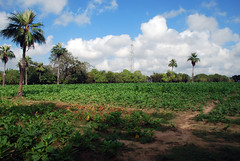
Over everything, Cubans live a humble life. The President of the University lives next door to shop keepers and laborers in nearly identical conditions. For his high position, he is rewarded with a car (which we got to borrow the other day). You’d be hard pressed to find a place where people are on such an equal footing than in Cuba. Yes, they are poor and opportunities can be considered limiting. I haven’t been able to find the kind of poverty that exists in the U.S. and other “first-world” countries though so like everything, you have to make a judgment on whether or not that is a good thing. The U.S. blockade of Cuba has made things very difficult here so it’s hard to say what life would be like if the current system were in place and the blockade not. Some things would be better, others the same, and others worse. U.S. development brings progress to other countries, but as we’ve learned, it also brings a lot of terrible consequences such as class conflict and environmental degradation. As I fully acknowledge that the blockade is inhumane, I also feel so lucky to be in a place where McDonald’s doesn’t exist and you can travel 15 minutes from the center of the city and be in the country side.

This is just the beginning of my thoughts about la situación cubana and as I continue to learn—and analyze—I’ll update things here. Hopefully in the next few weeks I’ll get some pictures put up so just keep an eye on the side bar on the right and if it looks like Cuba, there’ll be about 60 others on my Flickr site.


The End of an Era? What Fidel’s Message Means in La Habana.

19 02 2008

By now I’m imagining you’ve heard the “big” news—Fidel Castro has announced that he will not accept the Presidential nomination on Sunday when the National Assembly meets.  You may be thinking that La Habana is about to explode, but on that note you would most certainly be mistaken.  I am staying in the heart of the city—in an area called Plaza de la Revolución—and didn’t find out about Castro’s announcement until about an hour and a half after I woke up.  Even then, I found out by logging onto my email and seeing a breaking news alert in the Boston Globe.  It certainly isn’t breaking news here.  It’s just the official story of what everyone already knew.

Castro made his announcement at 5:00 a.m. today when the official newspaper of the Cuban Communist Party (PCC) Granma appeared at newsstands.  Castro had been promising a “mensaje” of great importance today and he certain didn’t let the Cuban people down.  A quick history lesson—Castro assumed power in 1959 meaning he has been Cuba’s leader for 49 years.  This is certainly an important day for Cubans, but more so as a formality rather than actual significance.  For those who believe now is a time of great transition in Cuba, I would say that transition began over a year and a half ago.

Our orientation at La Universidad de La Habana went along as scheduled, but we talked to a lot of people about the significance of today along the way.  The overwhelming feeling here is “no pasa nada” or, nothing’s happening.  The Cuban political system is far from being unstable.  You can bet that Fidel has been planning this moment with excruciating detail for the past year.  You can also bet that so long as he is living, he is going to be consulted on important decisions.

Nevertheless, on Sunday the National Assembly (of which Fidel is still a member) will elect its new leaders and there is still some speculation on who will become Cuba’s next president.  Next week will truly be the beginning of a new era in Cuba, but you won’t notice many (if any) changes on the street level.  I’ll keep you informed and please email if you have questions.


First Day

18 02 2008

I’ve still got much to do, but I arrived in La Habana this afternoon and moved into my new home for the next few months– El Costillar de Rocinante. I’ve put up contact information so if you send something my way, hopefully it’ll get here in a few weeks. Until then, you can send me an email though I’m having trouble with my gmail account so please use my school one for now until I sort that out. By the way, check this out– the part of La Habana I’m staying in is called Vedado, but more importantly, the neighborhood is “Plaza de la Revolucion.” Word.

It’s about 80 degrees here right now with beautiful skies. Tomorrow should be a great day to explore the city and hopefully by the end of this week, I’ll have a better chance to reflect on the beginnings of my semester here (and get something up here in Spanish).


Why do you want to go to Cuba? ¿Porque quieres ir a Cuba?

23 11 2007

Why do you want to go to Cuba? This is a question I have been asked many times in the recent months I have spent trying to find a way to do just that. There is no simple answer, but let me say that I truly believe it is impossible to learn about the Cuban situation here in the United States. Here, Cuba is almost a mythical place. Of course, Cuba is a very real place that since 1959 has been trying to counter the ideologies of neoliberalism and U.S. aggression. I want to learn first-hand, even if it’s only for a few months, how this social project is working. I want to discover how a society puts ideas like equity and social justice into practice. I want to see its triumphs and its failures. At the same time, I want to return to the United States and help dispel myths about the island that is so close, yet so far to us.

###

¿Porque quieres ir a Cuba? Me han hecho esta pregunta muchas veces durante los últimos meses mientras intentaba encontrar cómo hacerlo. No hay una respuesta sencilla, pero puedo decir esto: creo que es imposible conocer la situación cubana desde los Estados Unidos. Aquí, Cuba es un lugar casi mítico. Sin embargo, Cuba es un lugar real. Un lugar en donde, desde 1959, se han tratado de subvertir las ideologías del neoliberalismo y se ha resistido a la agresión estadounidense. Me gustaría ver por mí mismo, aunque sea por unos meses, cómo funciona este proyecto social, descubrir como esta sociedad pone en práctica ideas como la equidad y la justicia social, ver sus triunfos y también sus fallas. Al mismo tiempo, quiero regresar a los Estados Unidos y poder ayudar a cambiar los mitos sobre esta isla que está tan cerca y a la vez tan lejos de nosotros.